Running should feel natural

Running should feel natural

Monday, March 25, 2013

My Most Miserable Miles

My Most Miserable Miles


Every runner has those workouts that just go terrible for one reason or another.  Fatigue, hunger, dead legs, sleepyness, sore muscles -- the list goes on.  Friday I had probably my worst run yet.  Lately my weekends have been packed with activities (also known as commitments, some involving out of town travel which makes getting a long run in very difficult), so I worked extra during the past week to facilitate a long run early Friday afternoon.

My long run rules (which were all disobeyed): 
  • Give yourself plenty of time - time to get ready, time for the run (taking into account breaks), time to stretch, cool-down, and mentally unwind after.
  • Get a full night's sleep - either a solid 8-9 hours of sleep the night before, or at least run first thing in the morning so you are fresh.
  • Don't go out hungry - in fact, I like to eat 1-2 big, carb-filled meals within 36 hours of a long run.  Working off a light dinner and breakfast is not enough to get you through.
  • Don't run long after work - work is mentally exhausting and tires you out.  Trying to squeeze in a long run after work in the evening is difficult and can off set the rest of your week as well. 
  • Don't go long if you are sore/ dead-legged.  It sucks when you have "dead legs", the term for general soreness and fatigue that runners get from time to time.  
I should elaborate on the “dead legs” rule.  It’s hard to tell why you have dead legs.  Sometimes its from overtraining, sometimes its even from undertraining, and sometimes you just have no idea why you feel so tired.  While you can still pound out some shorter training runs you really shouldn't attempt a long run on dead legs (with the exception being the 2nd day of a focused back-to-back long run weekend).  Most of the time when you head out feeling tired your legs and cardio have a habit of “waking up” 20-30 minutes into a run.  This was not the case Friday.

It was almost surreal.  Within the first mile I felt as if I had just finished a marathon.  I wanted to stop, or at least slow down.  4 miles in, after tip-toeing a bit around some rocky terrain on the Potomac Heritage Trail I stopped and sat down; this is usually a mistake because you don't want to get back up and laying down is the next logical decision.  The idea of doing a 20-24 mile long run was out the window and at this point even the 16 mile option was too risky.  I opted for a tried and true trail loop of 12 miles.  This should get me back to my destination before my 3 hour cut-off (speaking of, I hate having a time cut-off to make!).  I trudged on, running across the key bridge into DC and on to the C&O Canal towpath.

I'll share some data - no laughing! 
Something was seriously wrong.  It wasn't dehydration at least - I wasn't thirsty and had my hand bottle filled with water + nuun just in case.  After about a mile of running I began alternating 5 minutes of walking and 5 minutes of slow running.  After a stop at Fletchers boathouse to use the restroom I continued my strategy until I reached Chain Bridge Road, ran across, and then began a long, slow walk up the huge hill to Military Road.  At this point I was able to employ the common ultra-running tactic of running down the hills and walking back up the next hill.  I made it to Difficult Run, walked up another huge hill, almost dizzy and stumbling at times, and continued walking through Arlington until I made it home.

Bam! 12 miles in 2 hours
and 23 minutes!
All I could do was lay there.

Not that I have a flair for the dramatic, or stressing over every detail of a run, but I rarely go into detail on any one training run.  Unless of course it was so memorable that it requires explanation.  Runs that are memorable in a good way are usually races where you set your Personal Best times.  You are reading one that was memorable in a bad way.

I still take positives from this.  It was a big system stressor, and (in theory) once you finish a workout like that and recover you get stronger.  Training for ultra running often involves a lot of walking.  During ultra marathons you typically walk up hills to conserve energy, and walking uses different muscles than running so you have to practice some.  I will be more cautious in the future too about safety, although I am already pretty safety conscious.  It’s a misconception that it has to be freezing out to get hypothermia but in reality if you are exposed and tired enough you can suffer from hypothermia in as warm as 55 degree weather.  It wasn't particularly cold that day (probably around 50 degrees F) but I’m pretty sure I was on the verge of hypothermia by the time I got home.

A workout like that also keeps your ego in check – getting passed by stroller runners and beginners reminds you that you are not a superstar.  It was a good experience in that I have a feeling what it probably feels like right before you DNF (or, “do not finish”) an Ultra, something even seasoned veterans of the sport contend with.  Another plus is that it was still 12 miles covered, even if by run/walking, and didn't do much damage to anything since it was so slow.

One last positive is that there is now little chance that I will set out on a run and worry its going to be my “worst run ever”, since the bar was just set pretty low!

Sunday, March 24, 2013

Going Green at Rock-n-Roll USA

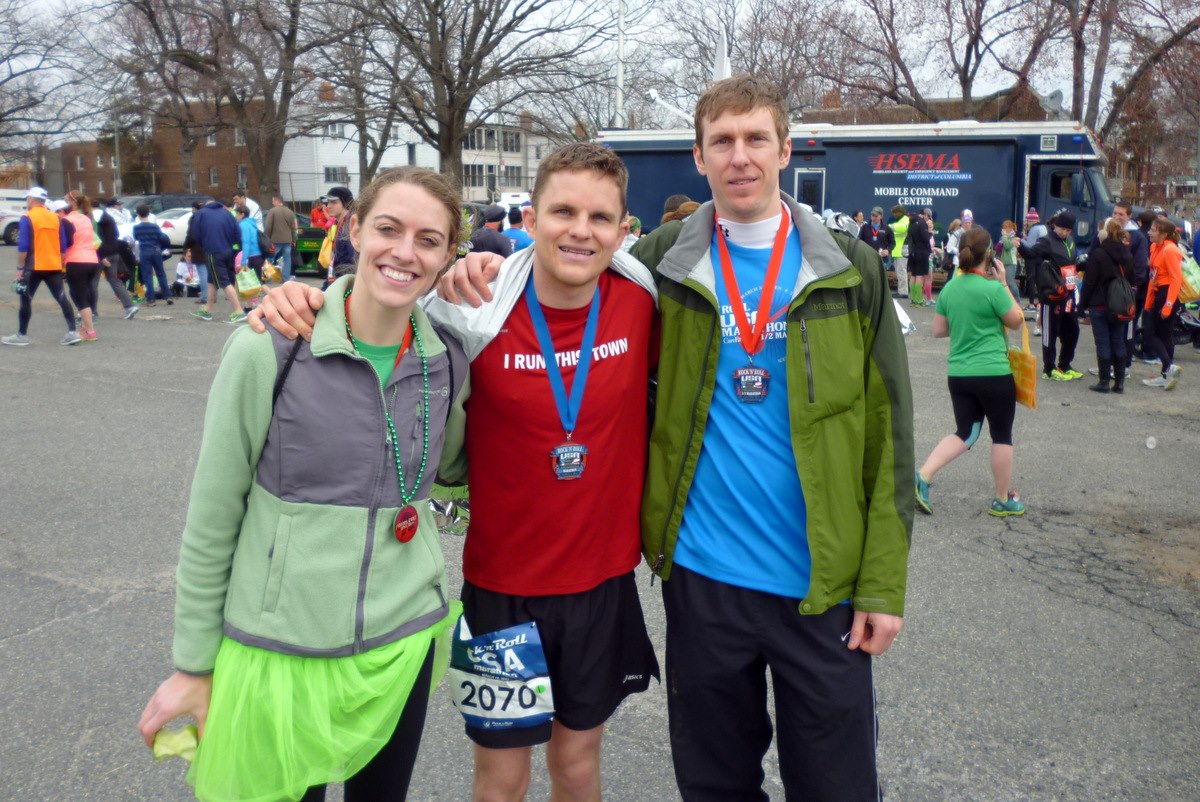
Rock-and-Roll USA Half-Marathon Recap

Location: Washington DC
Time:  1:35:29
Date: March 16, 2013

I signed up for the Rock-and-Roll USA Marathon last year.  Shortly after finishing the full marathon last year I was offered a discounted sign-up for this year (to lock me in early) so I immediately signed up.  It was something like $65, a real steal for a big race like this!  After my injury last fall and some so-so winter training I knew it wouldn't be wise to run a full marathon a month before Boston, so I switched to the half-marathon.  I also used this opportunity to not race (or, rather, attempt to PR), something I need to do more often if I want to continue to enjoy running for the long haul.  The plan was to pace a friend for his full marathon -- his goal being under 3:10, or a 1:35 half-marathon.

Oh, since it was a day before St. Patrick's day I also decided to incorporate some green into my outfit.  Enter: The Green Man.  I had always wanted to run a big race in a ridiculous outfit. This was a good opportunity to 1-up all the other people wearing green for St. Patty's day.  So Friday afternoon, I headed to the costume store on the bottom floor of the Ballston Mall in Arlington and at approximately 6:30 pm I was the proud owner of a green body suite.

This was a new challenge for multiple reasons.  13.1 fastish miles, no drinking, no spitting, minimal breathing, and a lot of sweating all over.  The weather cooperated pretty well that day, cool in the morning and no rain.  It felt nice starting off, but soon my head and neck were drenched in sweat.  Breathing was different, I had to take quick, sharp breaths in and out while curling my upper lip out.  Maybe I could market this as a training tool? Also, [very] fortunately, chafing was not an issue.  I was tempted multiple times to remove the headwear but I held out!

Logistics were no walk in the park either.  Getting to the race early enough to duck off where no one could see me to change, and then after the race finding another forested area to change back.  I wanted to stay anonymous during the race.  It was worth it though for the cheers, er, jeers, and well everything else.  I heard lots of "Green Man!" and "Green Dude!', as well as "Gumby", "Army Man", and even "Dinosaur".  Kids seemed to like it, asking "Why is that mean green?".  Shortly after running by most people I heard comments about the insane sweat marks around most of my body.  Overall, I'm saying it was a success!

This was a tough course, different than the past few years with several major hills, the largest of which was a super steep quarter mile as we left Rock Creek Park about 6 miles into the race.  This had everyone gasping for breath.  I fell behind my pace a little, but was able to make most of it up on the final mile (which was slightly downhill) with a final sprint to the finish.   Final time of 1:35:29, or a pace of 7:17 minute per mile.  I was happy with this - its purpose was served; to run a race with friends, to have fun, to get a decently long tempo run in, and (most importantly) to be ridiculous.

I am still giving this race a thumbs up, and while some people don't like the Rock-n-Roll branding I support it.  Apparently the National Marathon (as this race was previously known) was at risk for going under and this is a good market for Rock-n-Roll races so things worked out.  The course became more difficult with the inclusion of more and bigger hills in the first half this year, through running down toward Arlington Cemetery and through Rock Creek Park was a nice addition.  This was close to being a PR course in years past at the Half-Marathon distance.  The full Marathon wasn't "hilly" but it was by no means flat.  It would have been tough to hold your pace for the full Marathon this year.

After the Half-Marathon I waited around for my friends running the Full-Marathon, a much more admirable task and one that I'm still not sure I could pull off in a Green Man bodysuit.  Here's to hoping!

Great job to Randy, running 3:08 in only his second
 Marathon - the kids a natural!

Sunday, March 17, 2013

Less can be more when it comes to Road Runner Races, and Fort Hunt 10k Recap

Less is More: Small Club Races can offer a different experience than big gigs

Last weekend I ran a small club 10k, the Fort Hunt 10k (more on my experience at the race later).  I realized something, despite seeming irrelevent and pointless to some, these tiny road runner club races bring out the true runners, the purists, who just want to race against their peers.  They don't care about the race schwag, post-race party, or getting a shot at an age group award.  They just come out to run.

I started looking at some stats.  Also that weekend was the 4 Courts 4 Miler race, a great community run through Arlington that I have thoroughly enjoyed running in past years.  4 Courts however has a lot more of the buzz and pizaz of a typical sponsored road race, and an entry fee of usually 30-40 bucks.  My club 10k was free, but I think of the cost as being negligible since the race fee does tend to get you a tech t-shirt and post-race alcoholic beverage.

Now, back to the stats game.  I would say a good indicator for a 10k is how many runners finish under 40 minutes, a respectable time for a 10k (minute per mile pace of 6:26).  To accurately compare this to the 4 Courts 4 Miler I will normalize the times for the 4 Courts race using the McMillan Running calculator as a baseline.  McMillan says a 40 minute finish in a 10k is equivalent to a 25:02 finish in a 4 Miler.  4 Courts starts downhill but has a big climb at the end too, so lets round up to 25:10 for the purposes of this study.

4 Courts 4 Miler - Finisher Info (with times normalized to relative 10k baseline time)
  • total number of finishers: 1,552
  • winning time: 20:18 (32:26)
  • time of 10th place finisher: 24:53 (39:46)
  • percentage of finishers under baseline time: less than 1% (14/1,552)
Fort Hunt 10k - Finisher Info
  • total number of finishers: 76
  • winning time: 36:18
  • time of 10th place finisher: 39:54
  • percentage of finishers under baseline time: 14.5% (11/76)
Nothing beats an "official" looking race clock!
What conclusions can one draw from this?
  • About as many "fast guys" show up for small, community races as do for big races with high numbers of participants (10th place finish of both races was very similar time and effort).
  • The winner of big races is more of an "elite" status than smaller races, most likely because there is prize money on the line, and they are often sponsored by the same running company that puts on the race!
  • Big races are better for casual or beginner runners looking to have some fun - there just isn't much to get excited about in no frills small races if you already don't love to run.
  • The general [running] public will pay a race fee to get a bigger production with shirts and a post-run party.  Purists are more in it for the run only and could give or take the extra goodies and race fee.
  • Marketing works - big visibility from marketing and advertising with incentives (like goodie bags) draw out much bigger crowds than small races (where you usually have to be "in the know" to even know they are going on).
Most of these conclusions should not come as a surprise, but as an engineer with an affinity for data and over-analyzing that data I find it interesting to compare!


Fort Hunt 10k Recap:

Okay, back to my actual racing experience.  After checking last years results I had ambitions of maybe placing in the top 3 finishers.  Having run under 61 minutes at the Army 10 miler about a year and a half ago, I felt like I am capable of holding 6 minute miles for a 10k (which would net close to a 37:15 time), however, I was in peak shape back then with a focus on speed.  Since then I have been focused more on distance, and am still in kind of a comeback phase after my leg injury last fall.  I ran a mile to warm-up, felt stiff, tired, and dead-legged.

When the race got underway I soon adjusted my goal to just breaking 40 minutes.  I was able to keep up mostly steady splits and found a pack gunning for a sub-40 to stick with for the final 2 miles.  I was happy enough to be running moderately fast, especially on dead legs.

The course itself was great.  5 mostly flat laps on an access road around Fort Hunt park.  The weather was cold for standing around (probably upper 30s, dry and clear) but great for racing.


Almost there!! I am NOT going to finish
above the 40 minute mark!!

Rock-n-Roll USA Half-Marathon: This Weekend

Looking forward I remain cautiously optimistic.  The sore ankles and dead legs was a bit of a setback but mostly a mental one.  The Rock-n-Roll USA half marathon is this weekend.  I am getting excited about the buzz of a big city race and am happily pacing a friend for the first half of his marathon.  He wants a sub 3:08:00 Marathon, so I am making him to an even half-marathon split of 1:34:00.  This shouldn't feel "fast" for me, but enough of a workout and enough to test the waters for my ability to run at a faster pace for a long period of time.  I am tempted to run the full, but that would be a foolish, unneeded risk in my journey to get to the starting line at Boston healthy and injury free.  Successful completion of this half-marathon in my planned time should mean I am in good shape for Boston.
Me and a few buds after the race last
year.  Randy (blue shirt) is shooting fora
3:05 Full.  I'll be pacing Reza (white shirt)
for a 3:08 Marathon.

Me running this race last year, with
 the Capital building behind me.

Friday, March 8, 2013

Running in Austin

Running in Austin, Texas

Last weekend I took a trip to Austin, Texas for a wedding and like any running addict made sure to pack my shoes and running clothes, as well as check out some local groups and trails ahead of time.  Shortly after landing and picking up my rental car I was pleasantly surprised at the 70 degree daytime temps and full sunlight, a welcome respite from Winter back home in D.C.

 
The Zero Mile Marker.  Meeting point
 for  Al's  Ship of Fools, the Austin
running group I met up with.

Saturday morning I ended up running with the "Al's Ship of Fools" Saturday Long Run group, a bunch of friendly folks like you might find in any city.  I got there early and did a mile to warm-up, met up with the group at the zero mile marker of the Lady Bird Lake Trail, and got started promptly at 7:00am.  We did a 10 mile loop around Lady Bird Lake and then I tacked on another 3 miles for a total of 14.  I hope to return someday for the Austin Marathon, which just took place a few weeks ago.


View of downtown Austin across Lady Bird Lake with the packed dirt trail
in the mid-ground.  RunTex provides the water filled coolers for runners.
Even though it was a nice running atmosphere mixed with friendly people I still missed the seemingly endless tirade of urban trails that I have gotten used to in the D.C./ VA area.  My other attempted run on this trip was not around the Lady Bird Lake trail system and ended up involving a lot of street crossings and zig-zagging through neighborhoods.  I still managed to get in 10ish miles Monday in ever-changing, windy weather.  Speaking of weather, while it was great to experience highs in the 80s during winter I don't think I could deal with any season other than that down here.  Apparently highs in the 110s is the norm all summer.


The State Capital of Texas in downtown Austin.  About a
mile from the Lady Bird Lake trails via Congress Ave.

Non-Running Related Activities

The actual wedding was outside of Austin in Liberty Hill, TX.  The ended up renting out this eclectic house restored by a hippie couple from the city.  Think of a bed & breakfast, but not pretentious and covered with originality.  The first floor of the house was completely open and used as an eating area. The 2nd and 3rd floors were covered with hippie art on all the walls.  Each room had its own theme as well.  The outdoor areas were just as cool, with several firepits and seating areas.  The backyard had a dock with a rock swing to a nearby creek and across the water were some bluffs.  All the low hanging branches outside were adorned with tiny mirrors that made for a great effect when the sun shined through (pictured).

Tiny mirrors in all the tress (in focus), with the rest
 of the backyard and bluffs out of focus.


The annual Zilker Kite Festival was on the Sunday we were there and I was happy to get to check it out.  It has taken place for something like 85 years and counting and its a big "to-do" in town.  Plus, I'm a fan of free activities that include good people watching.  The lax atmosphere was a nice break from the constant presence of security officials, bag checks, and controlled access points that I have gotten used to in D.C.
I was able to check out the Zilker Kite Festival, held the
first Sunday of each March in Zilker Park.

The Cathedral of Junk is an art installation started over 20 years ago in a private backyard.  It began as a collection of junk and hubcaps but continued to grow.  It is now 3 stories high - the owner obtained a building permit to keep it up.  The 2nd floor is accessible by stairs and the 3rd floor by ladder.  It was also featured on Roadside America, an online guide to off the beaten path tourist attractions. The Cathedral has to be experienced in person to be fully appreciated.


The "Cathedral of Junk" -- probably one of the coolest
"off the beaten path" attractions I have seen!


Wednesday, March 6, 2013

Pounding on the Pavement


I finally got in a long training run on pavement in prep for Boston.  I hadn't originally planned on doing this on a weeknight, but I'm racing my next couple weekends so that complicates things, and DC had a big bout of snow and slushy weather coming into town today that would make doing a long training run less than fun.  I was also a bit tired from a surprisingly good weekend of miles while out of town in Austin, TX (to be recapped shortly).

Not to complain, but weeknights can make for a tough long run.  You are most likely tired, you worked all day, might not have gotten to eat the way you wanted, have to deal with darkness, and more than likely no one else is doing a long run so finding company is challenging.  Al these factors are not ideal.  I prefer to do my longest long runs on the weekends, preferably Saturday Mornings but as is typical with marathon training you need to re-adjust along the way to work within your constraints.

So I headed out last night for a long run at 5:40pm.  This was a daunting task so I broke it up into smaller segments - a good strategy for long training runs.  First, run to the track and run a mile on the track, that gets me 2 miles, then do one of my go-to loops in Arlington for 7.5 more miles.  At this point I will arrive at the Potomac River Running store for a group fun run, to get a drink and eat a Gu (well, HammerGel packets in "Montana Huckleberry" flavor to be exact) at 7pm.  Opting for the longer option I did 6.5 (very hilly...) miles with my group.  2+7.5+6.5 = 16.  After returning to the store I could have another Gu and a drink of water.  Then run the long way to get home for a little over 2 additional miles and voila! Long Run Done!

Good use of my Garmin.  I still
swear by my Forerunner 305.
The larger size never bothers me
and has plenty of space for a
4 square dashboard.  Battery
life is great too - I've never had
it die, even on over 5 hours
of use.
This was the plan, and it went mostly accordingly.  There were some tough miles in there.  It got dark around 5 miles in, so having to run solo in the dark when you are know you aren't even close to being done can be tough.  Miles 14ish -16 were tough too, getting tired at this point and a lot of uphill running.  The final stretch was mostly flat and I had a nice adrenaline boost provided by the thought of food, chocolate milk, and having a beer or 2 while watching the Washington Capitals NHL game that night.  Seeing the Caps come back from a 0-3 deficit to beat the Boston Bruins in overtime was the icing on the cake.
Pretty perfect pacing.  This was
taking into account a lot of stops
and turn-a-rounds, so the actual
pacing while running was closer to
around 7:45 min/miles.  The map was
a mess and really not worth sharing!

Although doing your long runs on trails will still get you in cardiovascular shape, its important to test your legs with long runs on pavement to simulate the stresses of marathon race day.  I would like to get one more 16-18 mile long run on pavement in, as well as 2 more long trail runs of 3.5 hours or more.  Another option I like to exercise is a combo (or hybrid) run - 12-14 on roads followed by 14-16 on trails.  The shorter option of one of these is great for marathon training, the longer routes are well suited for ultra training.

Monday, February 25, 2013

Training log last couple of weeks

Staying Cautiously Optimistic

Not a lot to report other than getting back into the swing of things.  Though this sounds boring, this is actually a good thing: being able to run frequently and have predictably pleasant longer runs on the weekends.  Here are my last 2 weeks of training with brief notes.  I start each week on a Monday.

Week of Feb 11:  total mileage: 32
  • Monday:  55 Minute Spinning Class, 20 minutes weights
  • Tuesday: 6 mile group Fun Run from PR in Ballston
  • Wednesday: Hill repeats, 5.5 miles, 3 x 1 mile hills at half-marathon effort, with warmup and cooldown
  • Thursday:  Rest (unplanned)
  • Friday: 4 miles easy (usually my rest day but had to make up for Thursday)
  • Saturday: 12 miles, approx 5 on roads with group and 7 more on trails solo
  • Sunday: Hill repeats, 5 miles total at half-marathon effort, with warmup and cooldown
Week of Feb 18: total mileage: 43
  • Monday: 55 Minute Spinning Class, 30 minutes weights
  • Tuesday: 6 mile group Fun Run
  • Wednesday: Track workout, 6 miles total, 2 x 400M, 200M job, 2 x 1600M, w/ 400M jogs, 1 x 800M, 400M jog, 2 x 400M, w/ 200M jogs.  All at planned 10k race pace of 6:05 minute miles.  The "jogs" were all active recoveries between intervals.  Great workout!!
  • Thursday: 8 miles easy group run
  • Friday: REST
  • Saturday:  16 miles easy, out and back route on C&O Canal Towpath (softer than roads!)
  • Sunday: 8 miles easy, excitedly wearing only shorts and a tech t-shirt in warm weather!
16 miles out and back on the C&O Canal (in red). Went pretty perfect!


Things still don't feel perfect in my legs.  I believe that my calves are still getting fatigued from the longer runs and this is causing the rest of my lower legs to feel a bit off.  Each time it gets sore, recovers and then goes away - this should mean its getting stronger too.  As much as I want to go out and basically go crazy, do some back-to-back 20 milers, multiple marathons, and 10+ mile tempos I know I need to throttle back and ease into it.  Seems to be going well so far - once the weather warms up that will be much tougher.

In the last 6 months I have really been changing up my running form and mechanics, from heavy heal striking (and pronating), so a smoother, lighter, mid-foot strike.  I still think this will pay dividends in the long haul, but in the meantime my calves are still used to the old style and it takes time to adapt to anything new.  At least its not the shock to my system that I was experiencing last last summer, the shock that led to a stress fracture that kept me off my feet for 6 weeks.

Reflecting


A friend asked me if I would still have gone back and run Chicago if I had known it would mean incurring an injury that would keep me out 6-8 weeks and take multiple months more to fully recover from.  My answer: Yes.  Running Chicago was the culmination of over 4 months of training with significantly more mileage than I had ever done before.  When I got to the start line I knew today was the day.  One of the flattest looped courses around and perfect 40 degree weather.  I recently received the final results in the mail, so I'll use that was one last chance to relish in my accomplishment.

Nice hardware.  I had my name,
place, and time inscribed
on the back!
Cut out of the official results page.  Apparently it was a
5- way tie!!  Now its time to move on...


Its funny looking back, I wasn't training specifically for a marathon last summer; just trying to get more into ultra-marathons by using trail running, higher mileage and back-to-back long runs on the weekends, while maintaining more marathon specific fitness through tempos and track workouts.  This makes me optimistic that if I can get back into pure marathon training (accompanied by all the other things) in the next year or two I can lower my PR into the low 2:50's.  Thats obviously a long way off.


Tuesday, February 19, 2013

Gear here, and how I hydrate


But First... Decently long training run

Saturday I headed back out for another longish run, or what would have been known as a mid-length run last summer.  I started out on pavement with my Saturday Long Run group, but then broke off about 4 miles in to tackle primarily trails.  Come to think of it, I should be focusing more on trail running than anything else when it comes to long runs.  The only long road race I have this spring will be the Boston Marathon, so while I should get at least a couple of 20+ mile road runs in before then, running on trails serves dual purposes: gets me in shape, and prepares me for the trail runs I have coming up in Spring and Summer.  Not to mention running on trails is way more fun than pavement!

My Saturday morning run ended up being a little over 11 miles, but at about 1 hour 40 minutes it felt longer.  That is the essence of running trails, while walking up (and down) steep hills, and slowing down to conquer especially rocky patches your minute-per-mile pace gets dragged down way slower than you would expect. All part of the fun!

No better way to start the weekend!

Gear Reviews


I decided to start reviewing gear I use for running, mostly shoes but also other accessories.  I will start cross-posting the shoe reviews in a new blog page appropriately named "Shoe Reviews", and other non-shoe gear will show up on the "Handy Runner Items" page.

These reviews are purely meant to be unbiased, objective opinions from an enthusiast (though completely non-elite) runner.  I do not "endorse" any company, but I believe in some forms of Capitalism: namely, if a product is good I will sing its praises, if it is inferior I will discourage others from using it.

How I Hydrate on the run


In my years as a runner I have been experimenting with difference hydration options.  At first I got comfortable with using a Nathan 2 bottle Fuel Belt (to be reviewed separately).  This worked well enough on mostly flat roads, allowed me to refuel at working water fountains and carry extra supplies in the provided pocket.  Taking this on the trails was not successful though, as all the added jumping and varied terrain made the bottles jump around (and sometimes fall out) on occasion.  I had tried using two 10 ounce hand bottles and that seemed to work all-right but was never great. Plus, the valves were the slider kind that click into place so I would either have to pull it with my teeth or use my dirty, sweaty hands.  Not to mention having both hands occupied was inconvenient.

My next option was a larger bottle only worn on one hand.  If you watch most elites during ultra trail races (mostly 50k, 50 Miler, and 100k) they usually seem to prefer the 1 hand bottle system - I assume they know what they are talking about.  This seems to be working out great for me so far, and I plan on using it even on shorter distances once the weather heats up this summer.  Enter the Camelbak Quick-Grip 21 with Podium Chill Insulated Bottle.


Camelbak Quick-Grip 21 with Podium Chill Insulated Bottle

I heard good things about this bottle by word of moth, and the "Jet Valve" intriged me.  The bottle itself can be bought separate from the hand grip if desired, but I needed both.  The bottle is insulated, meaning that it keeps cold drinks cold and warm drinks warm (at least for a while).  More importantly, it means that your hand doesn't start freezing on one side if you have a cold drink in the bottle while carrying it.  The "jet valve" works fantastic while running.  You can turn a switch to completely lock it, or set it so that you can get a drink by simply squeezing the bottle at your mouth, no need to bite the mouthpiece or switch a slider every time you need a drink.  With a 21 ounce capacity this should be sufficient to sustain a trail runner for at least an hour of activity, or about 7 miles of trail running.  Watch out for hot summer races though if the aid stations are spaced out any more than that though.

The hand grip is simple: stuff the bottle in, slide your hand through the elastic loop and off you go.  There is a strap you can tighten if you need more stability.  There is a small pocket to pack a few essentials.  My trail running essentials?  Usually a couple drink tablets, a Gu, a card with my name and emergency contact information (just in case), and a 5 dollar bill - oh, and some toilet paper.
Bottle + Nuun + Water = Hydration!


Nuun: electrolyte enhanced drink tabs

Though I had heard of Nuun before, I hadn't really started trying it until it was recommended to me by my friend, training buddy, D.C. blogger and ultra running extraordinaire Emily.  Nuun is an electrolyte enhanced drink mix, in tab form, that you can drop in a bottle of water.  Same idea as Gatorade, but with more of the good stuff (electrolytes) and less of the bad (sugar).  Its less syrupy than Gatorade too, which is usually a good thing (tastes lighter) but when you really need something to fill you up this might be a downside.

Nuun also comes very conveniently packed in waterproof tubes each containing 12 tabs.  The tubes are easy to throw in a gear bag, or camelbak to be brought along on a run or hike.  They aren't perfect though, the resulting drink is lightly carbonated (anything in tab form will have some fizzy-ness associated with it), the downside being that if your bottle isn't sealed air tight it may leak and or squirt a bit.  This used to be a real pain with the old hand bottles I used, and really bad on my Fuel Belt, but since switching to the single 1 hand bottle system (see review above) it seems to be fine.